
Five drills reliably build cricket power: tee sweet spot hits, overloaded swing reps, machine or throwdown timing work, braced front leg swings, and randomised short burst hitting. Tee work grooves impact location, overload reps build bat speed, timing drills sharpen reaction, and braced leg swings add leverage. Run each in blocks of 3 to 4 sets of 8 to 12 reps, and you will feel the difference within a fortnight.
Key Takeaways
Effective cricket power development relies on combining impact location drills with overload bat speed training, which together account for most variations in ball speed.
| Point | Details |
|---|---|
| Impact location focus | Practicing accurate impact points on the bat enhances power more than just increasing strength or bat speed. |
| Overload swing training | Using slightly heavier bats in short, repeated sets helps increase bat speed and improve overall hitting power. |
| Systematic practice structure | A structured session alternating technical, power, and simulation drills optimizes skill transfer and power gains. |
| Consistent indoor practice | Indoor facilities with lanes and measurement tools provide reliable conditions for tracking progress and refining technique. |
| Kingscricketacademy approach | We recommend combining impact and overload drills regularly and using precise measurement methods to improve power in cricket. |
Table of Contents
- How to do each drill correctly: step-by-step execution and coaching cues
- A practical progression: sample 60 to 90 minute session and weekly plan
- What the research says: bat speed, impact location and separation
- Equipment and bat selection for power training
- Measuring progress: radar, HD video and low-tech field tests
- Common faults that blunt power and quick corrections
- Where to practise these drills and measure gains: Kings Cricket Academy options
- FAQ
- Sources
How to do each drill correctly: step-by-step execution and coaching cues
Getting the setup right matters more than the drill name. Here is how we run each one in a net or lane session.
- Tee sweet spot hits: place the tee at hip height, aim for a marked zone on a net or mat, and cue “hands through, head still” so contact lands on the meat of the bat rather than the toe or handle.
- Overload and underload swings: use a slightly heavier training bat for 8 to 12 reps, then switch straight to the match bat for the same drill so the lighter bat feels faster by comparison.
- Machine or throwdown timing drills: vary ball spacing and length between deliveries so the batter reacts rather than anticipates, which builds genuine timing instead of a rehearsed swing.
- Braced front leg drill: set the front foot firmly before the ball arrives and swing from a stable base, rehearsing the hip-then-shoulder sequence that Australian coaches have borrowed from baseball-style swing training to add leverage on hard length deliveries.
- Resistance and plyometric link drills: use light resistance bands on the hips during slow-motion swings to connect leg drive to hand speed, then remove the band and repeat at full pace.
Keep overload work to short blocks. Technique breaks down once fatigue sets in, and a tired swing teaches the wrong habit.
Pro Tip: Film every third rep on a phone propped behind the stumps so you can check impact location without stopping the session.
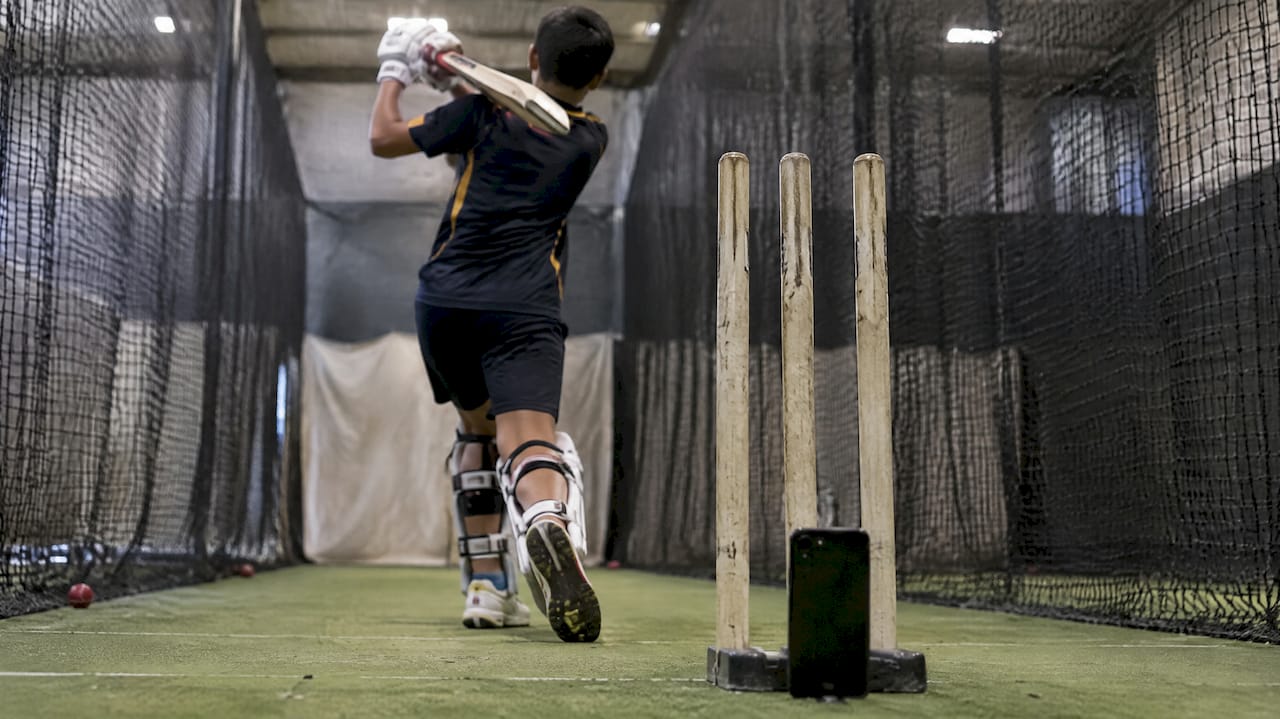
For players wanting corrections tailored to their own swing, one-on-one drill sessions let a coach adjust cues in real time rather than waiting until the end of a net.
A practical progression: sample 60 to 90 minute session and weekly plan
A session works best when it moves from precision to power to pressure. Here is a structure we use across a 60 to 90 minute block.
- Warm-up and activation (5 to 10 minutes): light jogging, dynamic stretches, and a handful of shadow swings to switch on the hips and shoulders.
- Technical block (15 to 20 minutes): tee work and soft-ball hitting at low intensity, focused entirely on impact location rather than distance.
- Power block (20 to 30 minutes): overload swing sets paired with machine deliveries at a fixed speed, building bat speed while form stays controlled.
- Simulation block (10 to 15 minutes): match-speed throwdowns or boundary-target hitting, where the batter reacts to game-like pace and line.
- Cool-down and scheduling: light stretching, then rest. Repeat this structure two to three times a week, allowing at least a day between power-heavy sessions so the hands and forearms recover.
Juniors should shorten the power block and spend more time in the technical phase. Our junior cricket drills guide covers safe overload limits for younger players in more detail.
What the research says: bat speed, impact location and separation
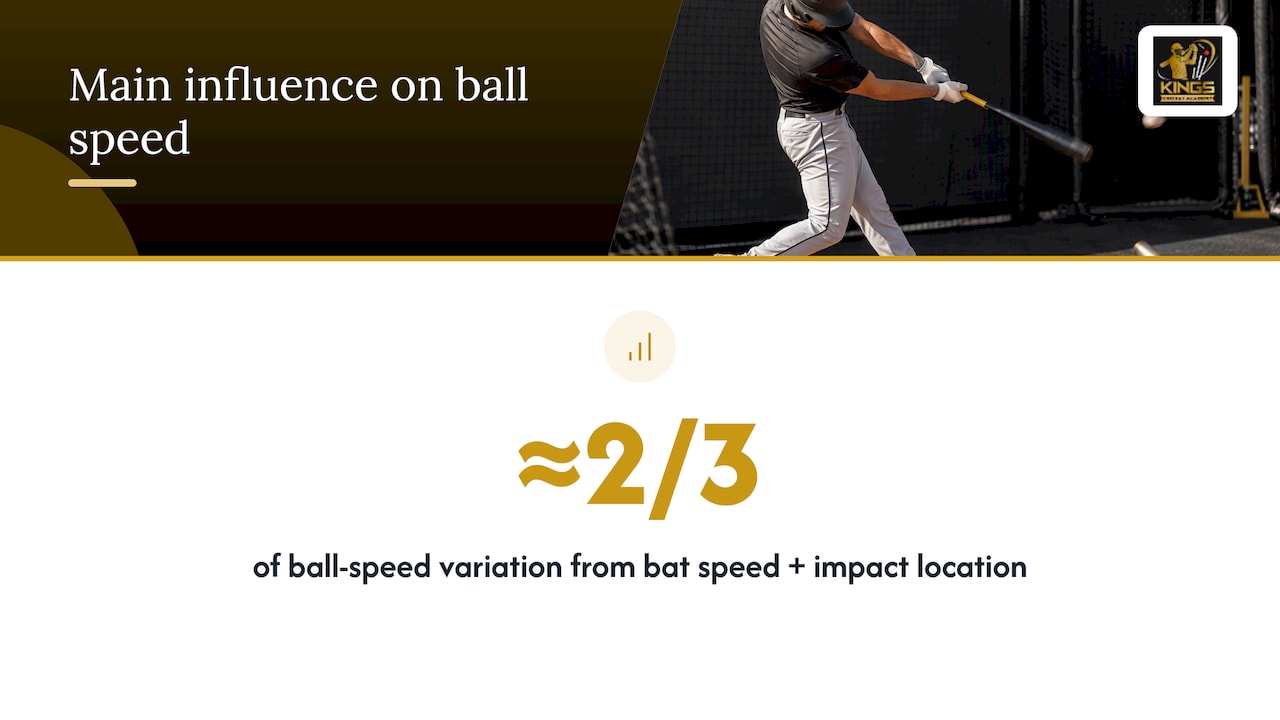
The biomechanics behind power hitting are well mapped, and the numbers point to two factors that matter more than raw strength. Pre-impact bat speed combined with impact location accounts for roughly two-thirds of the variation in post-impact ball speed, according to a study on bat speed and carry distance. That means two batters with the same bat speed can hit the ball very differently depending on where it lands on the face.
Separate research on kinematic predictors of bat speed found that pelvis-thorax separation, often called the X-factor, along with greater lead-elbow extension through the downswing, correlated with higher bat speeds among skilled batters. In practice, this means cueing hip rotation ahead of the shoulders, then letting the front arm extend fully through the ball rather than cramping the swing.
Facing genuine pace adds another layer. A balanced pre-routine before the bowler releases the ball gives batters a fraction more time to commit forward or back within the short perception and reaction window against fast bowling. A still head and a settled base before release is not a style preference. It is the difference between reacting in time and guessing.
Equipment and bat selection for power training
Swing-weight, not just overall mass, determines how fast a bat moves through the zone. Research on swing-weight shows that swing speed drops as swing-weight rises, so a bat that feels heavy at the toe can slow a swing more than its total weight suggests.
- Use a slightly overloaded training bat for short blocks only, then return to the match bat so the usual bat feels lighter and quicker.
- Avoid a bat so heavy that technique collapses, since timing drills lose their value once the swing path changes to compensate.
- Younger players generally benefit more from timing and technique drills than from heavy overload work, given their developing strength.
- Check swing-weight, not just stated weight, when choosing a bat for power sessions.
Parents and junior coaches choosing a bat for this kind of training will find our cricket bat size guide useful for matching size to age and strength.
Measuring progress: radar, HD video and low-tech field tests
Tracking numbers keeps practice honest. About two-thirds of ball speed variation comes from bat speed and impact location combined, as the range hitting study found, which is why both need separate tracking rather than judging power by eye alone.
- Use a radar gun to log post-impact ball speed, keeping the machine feed speed and line identical between sessions.
- Review HD video frame by frame to check hip, shoulder and hand sequencing against the impact point on the bat face.
- Mark distance zones on the ground and run a best-of-five protocol, recording the top two results each week.
- Set a progressive target, such as a consistent sweet spot strike rate, rather than chasing a single big hit.
Common faults that blunt power and quick corrections
Most power problems trace back to a handful of habits.
- Muscling the swing: correct with rhythm drills and an “85% effort” cue, since a slower, controlled swing often produces more bat speed than a forced one.
- Hitting off the toe or edge: correct with tighter tee placement and a narrow target zone to retrain impact location.
- Poor balance or rushed pre-routine: correct with rehearsed pre-ball routines and simple dual-foot balance drills before facing pace.
- Wrong bat for the task: correct by checking swing-weight and reducing overload bat use if the swing path starts to drop.
Where to practise these drills and measure gains: Kings Cricket Academy options
Running these drills well depends on consistent conditions, which is exactly what an indoor setup gives you. Our indoor facility includes lanes that run on bowling machines and radar speed monitors, so every session feeds at the same speed and line, with HD video analysis available to check impact point and sequencing without guesswork.

- Book a lane or bowling machine by the hour for self-directed drill work.
- Work through a structured power hitting plan with private coaching, including fast bowling and batting specific sessions.
- Set your children up with junior cricket coaching that scales overload work to age and strength.
- Train consistently with a 6 visit or 10 visit membership plan, priced at $300 and $450 respectively.
Book a lane, bring this drill list, and start logging radar numbers from your first session.
FAQ
What is the fastest way to improve power hitting in cricket?
Combining tee work for impact location with overload swing training for bat speed gives the quickest gains, since both factors together explain most of the variation in post-impact ball speed according to research on bat speed and carry distance. Three to four focused sets of 8 to 12 reps, repeated two to three times a week, tends to build noticeable change within weeks.
How often should I practise power hitting drills?
Two to three sessions a week is a practical starting point, with at least a day of rest between power heavy blocks so the hands and forearms recover. Juniors should lean more heavily on the technical block and shorten overload work.
Does a heavier bat make you hit harder?
Not necessarily, since swing speed drops as a bat’s swing-weight increases, according to research on swing-weight. A slightly heavier training bat used in short blocks can help the match bat feel quicker afterwards, but training on an overly heavy bat long term can slow the swing it is meant to improve.
Can I track power hitting progress without expensive equipment?
Yes, distance markers and a best-of-five hitting protocol give a reasonable low-tech measure of progress, especially when logged weekly under consistent conditions. Where available, a radar gun and HD video add more precise tracking of ball speed and impact location.
Where can I practise these drills indoors?
An indoor facility with bowling machines, consistent lighting and no weather disruption works well for repeatable practice. Our lanes at Kings Cricket Academy are set up with radar monitors and HD video specifically for this kind of structured, measurable training.
Sources
- Relationships between technique and bat speed, post-impact ball speed and carry distance during a range hitting task in cricket
- Kinematic predictors of bat speed in cricket
- Effects of swing-weight on swing speed and racket power
- Cricket
- The Ashes: Science reveals key to batting against England’s fast-bowling sensation Jofra Archer – ABC News
Recommended
- Cricket Batting Drills On 1 In Sydney: Improve Faster
- How To Choose The Right Cricket Batting Coach
- Cricket Training Tips