
The fastest way to raise bat speed is to train the downswing kinematics (pelvis-thorax separation, lead elbow extension and wrist uncocking) with targeted drills, measure progress with radar or bat sensors, and back it up with rotational power training. These three markers explain about 77.7% of the variation in bat speed between batters. Indoor machines and radar make this measurable and fast to coach, and every drill below scales safely for juniors.
Key Takeaways
Effective bat speed development focuses on specific downswing kinematics and rotational power training, which together explain most variations in bat speed.
| Point | Details |
|---|---|
| Optimize downswing mechanics | Focus on pelvis-thorax separation to generate rotational power and increase bat speed. |
| Enhance lead arm extension | Work on reaching full extension with the lead elbow at contact to improve swing effectiveness. |
| Control wrist uncocking | Delay wrist uncocking until just before impact for better timing and bat speed. |
| Integrate strength and power training | Use rotational throws and eccentric overload exercises to boost force production aligned with technical drills. |
| Utilize measurement tools | Apply radar or bat sensors regularly to track progress and personalize coaching adjustments. |
Table of Contents
- Three priority bat speed drills matched to the biomechanics
- Strength, power and mobility work that transfers directly to bat speed
- Designing indoor practice sessions with lanes, machines and radar
- Measurement, tech and tracking: what to use and simple testing protocols
- Common faults and quick fixes
- Progression and periodization for different levels and ages
- Nutritional and recovery strategies that support power development
- Psychological techniques to enhance timing and confidence
- Book a focused bat speed session at Kings Cricket Academy
- FAQ
- Sources
Three priority bat speed drills matched to the biomechanics
Most batters chase bat speed by swinging harder, but the research points somewhere more specific: pelvis-thorax separation at the start of the downswing, how far the lead elbow extends, and when the wrists uncock relative to impact. Together these three factors account for roughly 77.7% of bat speed variation, with a standard error of around 0.92 metres per second. That is a tight enough relationship to build an entire practice block around.
- X-factor downswing drill: set up in your normal stance and exaggerate the separation between hips and shoulders as you start the downswing, almost like winding a spring. Begin with shadow swings focused purely on that separation, add light medicine-ball rotational throws against a wall to groove the sequence, then move to machine feeds where you try to reproduce the same separation at full speed. A coach or video check should confirm the hips are already turning before the hands start moving.
- Lead elbow extension drill: work off a tee or soft throwdowns and focus on reaching full extension of the lead arm at the point of contact, rather than keeping the arms bent and compact. Progress from single-arm swings (lead arm only) to resisted extension with a light band, then reintegrate both hands once the extension pattern feels automatic. The cue that works best in the nets is “reach through the ball,” not “swing fast.”
- Wrist uncocking and sweet-spot drill: use short, compact swings at a stationary ball or slow machine feed, aiming to delay the wrist uncock until the last possible moment before impact. Feed the ball to a central, repeatable spot so the focus stays on timing rather than adjusting to location, then gradually increase feed speed once the uncock timing is consistent. Impact location matters here too: research on bat-ball contact shows strikes within about 2 centimetres of the sweet spot side to side, and 4.5 centimetres along the bat’s length, reduce post-impact speed by less than 6% compared with edge hits.
These three drills slot neatly into a club session; our guide to cricket drills for junior players has age-scaled versions if you are coaching under-14s or younger.
Strength, power and mobility work that transfers directly to bat speed
Drills teach the pattern, but strength and power training give you more force to put through it. A field intervention study in elite female cricketers tested two approaches over a training block: conventional strength and power training, and supramaximal accentuated eccentric loading (SAEL), where athletes lower a heavier-than-normal load under control before a fast concentric lift. Both improved bat speed, with SAEL producing around a 7.9% gain and conventional strength and power work around 5.5%, alongside general strength increases. The study also flagged that female batters often solve the movement differently to male batters, so coaching cues and strength emphasis may need adjusting rather than copied wholesale.
Practical exercises that build this transfer include:
- Medicine-ball rotational throws against a wall or with a partner, three sets of six to eight explosive reps.
- Band-resisted swings that overload the downswing without changing bat weight.
- Hip hinge and rotary stability work such as cable chops or Pallof presses to protect the lower back under rotational load.
- Eccentrically loaded squats or rows, lowered slowly over three to four seconds, done once or twice weekly in the off-season and scaled back to maintenance loads in-season.
A simple weekly split for an adult player might run two strength sessions and three to four net sessions, while a junior would do one light strength session and more drill-based net time, with loads kept well below adult eccentric training until growth and coaching supervision allow for progression.
Pro Tip: Build rotational power before adding bat-speed-specific overload drills, so the extra force has somewhere useful to go.
Designing indoor practice sessions with lanes, machines and radar
An indoor lane with a bowling machine and radar unit turns bat speed training from guesswork into a repeatable protocol. Start with five to ten minutes of dynamic mobility (hip openers, thoracic rotations) followed by short, bat-free swings and a handful of medicine-ball throws to switch on the rotational muscles before anyone picks up a bat.
- Technical drill block (around 30% of session time): run the X-factor, elbow extension and wrist-uncocking drills from a stationary ball or slow machine feed, focused on pattern quality rather than speed.
- Power and impact block (around 40%): increase machine speed and vary feed length so players have to time the downswing under realistic pressure, finishing with impact-location work aimed at a central target.
- Measurement block (around 20%): take radar readings or bat sensor data on a set number of swings so every player leaves with a number to beat next time.
- Cool down (around 10%): light stretching and a short debrief on what the data showed.
Rotate players through lanes in groups of two or three so one bats while another feeds or tracks numbers, which keeps work density high without turning the session into a queue. Machine settings should start predictable (same length, same line) before adding variation, since research on facing a bowling machine versus a real bowler notes that machines remove some of the anticipatory cues batters rely on in a match, so late-session work should mix feed types to keep timing match-realistic. Our one-on-one batting drills guide has more on structuring coach-led blocks like this.
Measurement, tech and tracking: what to use and simple testing protocols
Three tools cover almost everything a batter needs to track progress. Radar guns give you raw bat and ball speed numbers and are the simplest to set up in a lane. Bat-mounted sensors, such as the str8bat device, capture swing timing and impact zone and feed that data back so a coach can personalise adjustments rather than forcing one technique on every player. Accelerometers paired with video can validate exactly which phase of the swing is changing, and small bat-mounted sensors have been shown to correlate well with video analysis in controlled testing.
- Radar: fast, cheap to run in a lane session, but only gives you a top-line speed number.
- Bat sensors: add timing and impact-zone detail, useful for diagnosing why speed has stalled.
- Video plus accelerometer: the most detailed option, best used periodically rather than every session.
A workable baseline test is ten maximal swings off a machine or throwdown, using the median bat speed and the percentage of central impacts as your two numbers, then retesting every four to six weeks. Using a median of ten swings rather than a single best effort reduces noise from one lucky or mistimed hit, which matters when you are trying to tell a real improvement from normal day-to-day variation.
Common faults and quick fixes
Most stalled bat speed traces back to one of three problems, and each has a specific fix rather than a vague “swing faster” cue.
- Late downswing initiation: if the hips and hands start moving together instead of hips first, shorten the backswing and use metronome or delay-cue feeds to force earlier hip rotation.
- Inconsistent impact location: if contact drifts off-centre, narrow the target zone on the machine feed, slow the ball down temporarily, and mark the bat’s sweet spot so the player gets instant visual feedback after each hit.
- Plateau despite consistent training: check whether the bat itself is too heavy or poorly balanced for the player’s current strength, since this alone can cap speed gains, and consider booking a coach-led video session if the plateau holds for several weeks.
Progression and periodization for different levels and ages
A junior just learning the game needs far less load and far more repetition than an adult club player chasing marginal gains, so the drills above should be periodised rather than applied identically to everyone. For beginners and younger juniors, spend most sessions on the technical drill block at slow, predictable feed speeds, with strength work limited to bodyweight rotational movements and no eccentric overload until a coach has assessed movement quality.

Intermediate players, typically those with a settled technique who are chasing measurable speed gains, can shift the balance toward the power and impact block, introduce light medicine-ball throws twice weekly, and start tracking radar or sensor numbers every four to six weeks to guide load changes.
Advanced and adult players get the most from a structured block: a pre-season phase emphasising strength and power (including supramaximal eccentric work where appropriate), tapering into an in-season phase that favours drill quality, timing variation and maintenance strength work so fatigue does not erode technique. Across all levels, the principle stays the same: add load or complexity only once the current pattern is consistent, and scale volume down before a big club or representative fixture rather than during it.
Nutritional and recovery strategies that support power development
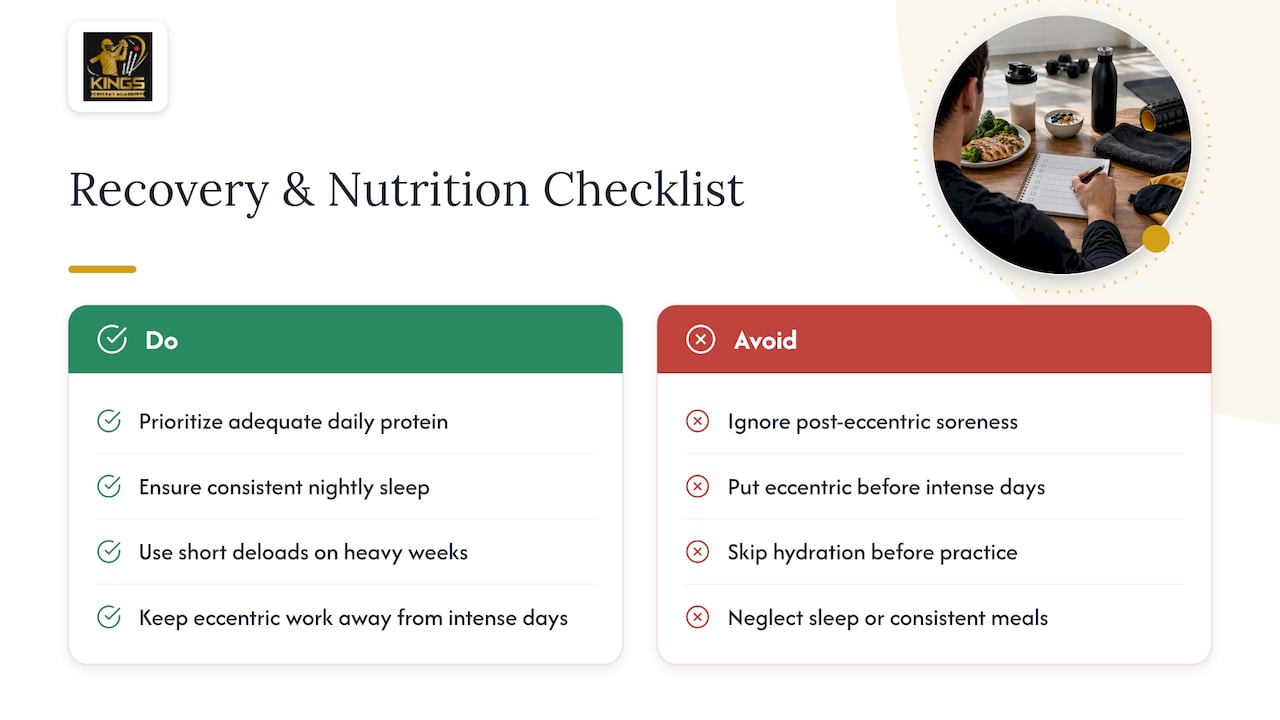
Power output depends on recovery as much as training, so the basics matter more than any specific supplement. Adequate protein intake across the day supports the muscle repair that rotational power training demands, and consistent sleep is when most of that repair actually happens. Players doing eccentric strength work in particular should expect more muscle soreness in the 24 to 48 hours after a session, so scheduling those sessions away from high-intensity net practice or matches gives the body time to adapt rather than compounding fatigue.
Hydration affects reaction time and coordination before it affects raw strength, which matters for a skill like timing a downswing. On heavy training weeks, a short deload period, lighter loads and reduced net volume for several days, helps consolidate the strength and power gains from eccentric or rotational training rather than letting fatigue mask them. None of this requires anything exotic: consistent meals built around whole food protein and carbohydrate sources, enough sleep, and respecting soreness as a signal to adjust the next session rather than push through it.
Psychological techniques to enhance timing and confidence
Bat speed is wasted if a player cannot commit to the shot under pressure, so timing work benefits from some mental preparation alongside the physical drills. A simple pre-ball routine, a consistent sequence of breath, grip check and visual focus on the bowler’s hand, helps batters arrive at the crease state ready to react rather than still thinking about the last ball.
Visualising the specific drill cue (hips first, reach through the ball, delay the uncock) in the seconds before a delivery keeps the technical work from the nets connected to match situations, rather than the two feeling like separate skills. Players who struggle with tentative, decelerating swings often benefit from naming the fault out loud in practice, since describing what is happening tends to make the next correction more specific than simply trying harder. Confidence at the crease generally comes from repetition under realistic conditions, which is part of why mixing feed types and speeds in training, rather than always facing predictable deliveries, builds the kind of adaptable timing that holds up in a real innings.
Book a focused bat speed session at Kings Cricket Academy
Reading about X-factor separation and wrist timing only gets you so far without somewhere to put it into practice and see the numbers move. An indoor cricket training facility with several lanes equipped with bowling machines and radar speed monitors, offering structured coaching with video analysis to help identify swing issues.

- Book a lane, coach and measurement block together to run the drills above with immediate radar feedback.
- Choose the 6 visit plan or 10 visit plan if you want to track bat speed changes over several weeks rather than a single session.
- Private coaching, including batting and fast bowling coaching, is built around the same measurable, drill-first approach covered in this guide.
Head to the booking page to lock in a lane and start turning these drills into tracked progress.
FAQ
What is the quickest way to increase bat speed?
The quickest gains come from combining downswing kinematic drills (X-factor separation, lead elbow extension, wrist uncocking) with rotational power training, since these three movement markers explain most of the variation in bat speed between players. Measuring progress with radar or a bat sensor speeds up the feedback loop so you know which drill is actually working.
Can strength training really improve bat speed?
Yes, a training study in elite female cricketers found that both conventional strength and power work and supramaximal eccentric loading produced measurable bat speed gains over a structured block. The heavier eccentric approach produced a slightly larger improvement, but both methods worked.
How often should I test my bat speed?
A practical approach is testing every four to six weeks using a median of ten maximal swings off a machine or throwdown, rather than a single best attempt, since using a median reduces noise from one unusually good or poor swing. Track both bat speed and the percentage of central impacts to see whether speed gains are coming with consistent contact.
Does where I hit the ball on the bat actually matter for speed?
Yes, impact location has a large effect on how fast the ball comes off the bat: strikes within about 2 centimetres of the sweet spot side to side and 4.5 centimetres along the bat’s length lose less than 6% of potential speed compared with edge hits. That is why impact-location drills sit alongside pure swing-speed work rather than being treated as a separate skill.
Is bat sensor technology worth using over a coach’s eye?
Bat sensors and coaching are complementary rather than competing: devices like str8bat capture timing and impact-zone data that a coach can then use to personalise technical adjustments for an individual player. Kings Cricket Academy pairs HD video analysis with radar speed monitors so coaches can combine both forms of feedback in one session.
Sources
- Kinematic analysis identifying X‑factor, elbow extension and wrist uncocking as primary predictors of bat speed
- Relationships between impact location and post‑impact ball speed, bat torsion, and ball direction in cricket batting
- Thesis: interventions to improve bat speed in professional female cricketers
- Article: technology to unlock batting data (str8bat coverage and coach perspectives)