
Run a progressive pre-season over a period of weeks with multiple sessions scheduled weekly, mixing skill work, conditioning and planned rest. Adult club players typically manage multiple sessions weekly including one conditioning day, while juniors do best on a small number of sessions plus games, with strict bowling limits built in from day one. The templates and week-by-week build below show exactly how to set it up.
Key Takeaways
A well-structured cricket pre-season involves progressively increasing skill, conditioning, and rest, tailored to player age and position to prevent injury and maximize performance.
| Point | Details |
|---|---|
| Progressive weekly build | Gradually increase training volume and intensity over several weeks, tapering before the first competitive match. |
| Structured session design | Divide practice sessions into warm-up, technical work, purposeful practice, conditioning, and cool-down for maximum effectiveness. |
| Respect bowling limits | Adhere to age-specific bowling restrictions and schedule rest days after bowling sessions to reduce injury risk. |
| Monitor load and recovery | Regularly track soreness, sleep, and perceived exertion to adjust training and incorporate planned deload weeks. |
| Kings Cricket Academy approach | Use indoor lanes, video analysis, and tailored coaching programs to efficiently develop skills without weather disruptions. |
Table of Contents
- Sample weekly schedule for adults and juniors
- Building an efficient 60 to 90 minute session
- Junior bowling limits and how to schedule around them
- Avoiding load spikes with planned deload weeks
- A pre-season plan over several weeks you can edit
- Drills that build real match skills
- Reviewing and adjusting the plan as you go
- How Kings Cricket Academy puts this schedule into practice
- Getting started at Kings Cricket Academy
- Where to check the detail on limits and recovery
- Sources
- FAQ
Sample weekly schedule for adults and juniors
A club adult player training three times a week gets the best return from one batting-focused session, one bowling and fielding session, and one conditioning or mixed-skills day, spaced across the week with at least one rest day between high-intensity sessions. Juniors generally need less volume, with fewer structured sessions plus a weekend game covers skill development without overloading a developing body.
Non-bowling days matter as much as bowling days. A junior fast bowler who bowls Tuesday should not bowl again until Thursday at the earliest, and a deload week every four to six weeks keeps cumulative load manageable, a principle drawn directly from Cricket Australia’s junior bowling guidelines.
| Player type | Sessions per week | Typical focus | Rest between high-load days |
|---|---|---|---|
| Adult club player | 3 | Batting, bowling and fielding, conditioning | 1 day minimum |
| Junior (under 15) | 2 plus weekend game | Skill blocks, small-sided games | 1 full day after bowling |
| Specialist fast bowler | 2 to 3 bowling-specific | Run-up, pace, accuracy | 1 day non-bowling after each session |
Indoor lanes and bowling machines suit the early technical weeks, where repetition and camera feedback sharpen mechanics. Live-bowler sessions should be layered in as the pre-season progresses, since machines cannot replicate the visual cues a batter reads off a real action.
Building an efficient 60 to 90 minute session
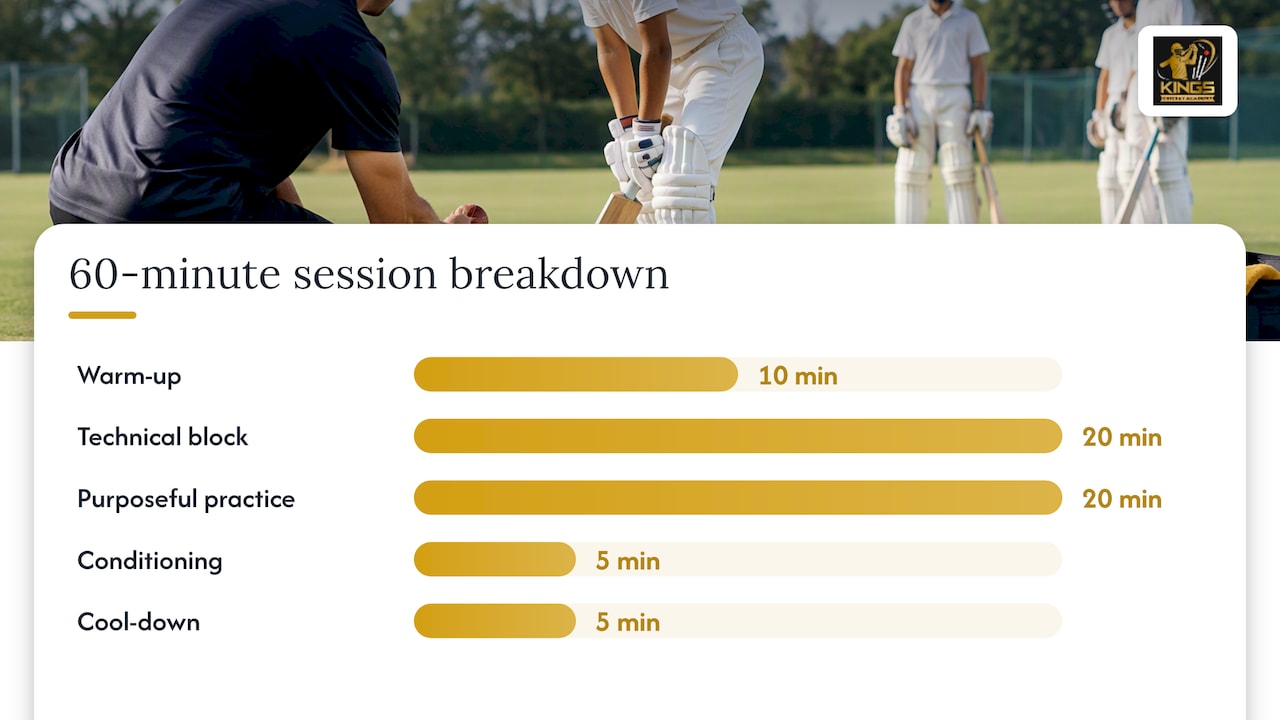
A session works best broken into five blocks: warm-up, a technical block, purposeful practice, conditioning, and cool-down. For a 60-minute session, allow 10 minutes warm-up, 20 minutes technical work, 20 minutes purposeful practice, 5 minutes conditioning, 5 minutes cool-down. Stretch a 90-minute session by adding 15 minutes to the technical and purposeful blocks and keeping the rest the same.
- Warm-up: dynamic stretching, throwdowns, light catching to raise heart rate and prime movement patterns.
- Technical block: bowling machine or sidearm repetitions for a specific shot or line, filmed for review.
- Purposeful practice: small-sided games or constrained net scenarios that force decision-making, not just repetition.
- Conditioning: short sprints, agility ladders or fielding-specific movement work.
- Cool-down: walk-through stretching and a quick debrief on what worked.
Purposeful practice is the block most clubs skip, yet it is where match-like decisions get trained. Setting a target score, a required run rate or a specific bowling plan turns a net session into something closer to the real thing, a point echoed in the Australian Sports Commission’s smart practice guidance.
Pro Tip: Film every technical block, even on a phone. Reviewing footage straight after the session fixes habits faster than a verbal cue alone.
Junior bowling limits and how to schedule around them
Cricket Australia’s age-based guidelines set the ceiling on bowling-day frequency and overs, and the safest pre-season builds respect them from week one rather than retrofitting rest once soreness shows up.
- Younger age groups bowl fewer days per week and fewer overs per spell than older juniors, with limits tightening around growth spurts.
- Schedule at least one non-bowling day immediately after any bowling session, never back-to-back bowling days.
- Build in a planned light week every four to six weeks, even when a bowler feels fine.
- Cap total organised training and game hours rather than letting cricket crowd out rest and other activity, a principle the Australian Institute of Sport applies to young athletes across sports.
During exam periods or rapid growth phases, drop volume before dropping intensity entirely: shorter, sharper sessions preserve skill without adding fatigue on top of an already stressed body.
Avoiding load spikes with planned deload weeks
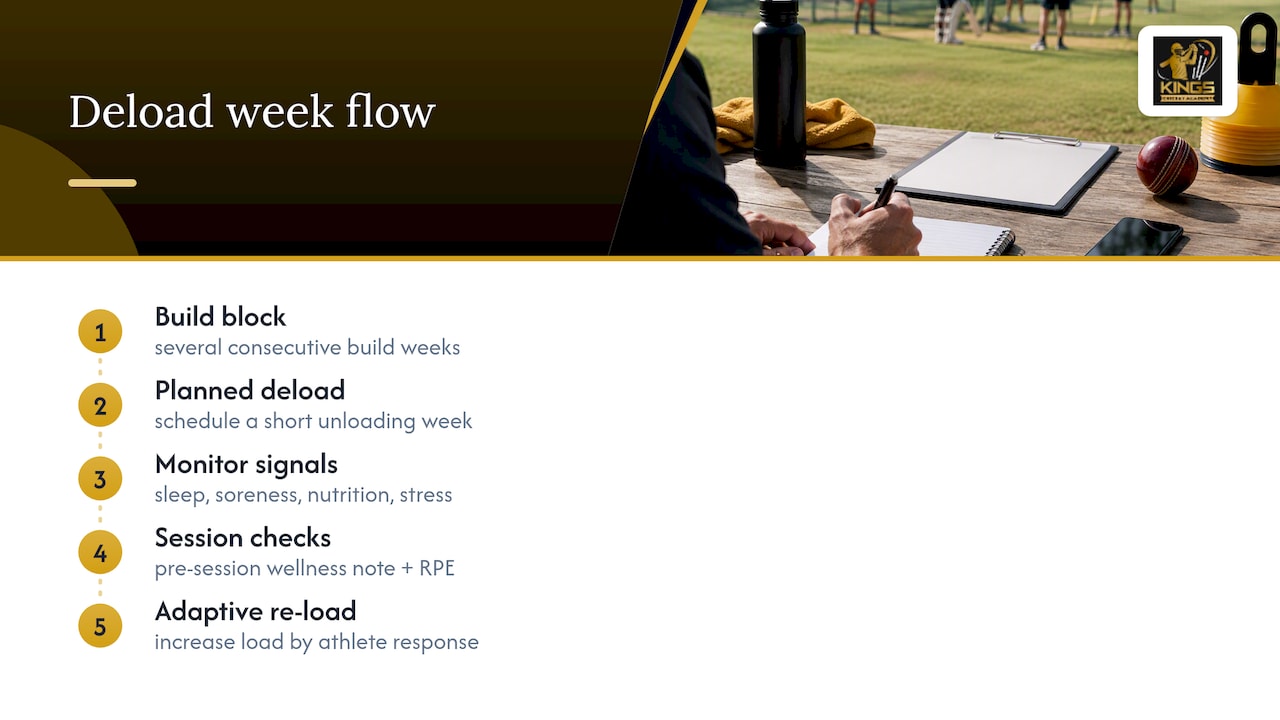
The biggest injury risk in a cricket pre-season is not high volume, it is a sudden jump in volume after a quiet period. The Australian Institute of Sport’s position statement on loading and unloading recommends planned unloading phases, with re-loading adjusted to how the athlete actually responds rather than a fixed calendar.
Monitoring that matters: AIS guidance points to sleep, soreness, nutrition and stress as factors that shift an athlete’s tolerance to planned load, meaning two players on the same schedule can need different adjustments in the same week.
Place a deload week regularly after several build weeks rather than waiting for a niggle to force one. A short wellness check, a quick note on sleep and soreness before each session, combined with a simple session rating of perceived exertion, gives enough signal to pull back a session without waiting for an injury to make the decision for you.
A pre-season plan over several weeks you can edit
This build assumes multiple sessions per week for an adult squad, scaled down to fewer for juniors, and taper the final week before the first competitive match.
- Weeks 1 and 2: base skills, low bowling volume, general conditioning and movement screening.
- Weeks 3 and 4: increase net volume, introduce match-length bowling spells at moderate intensity.
- Week 5: planned light week, technical refinement only, no conditioning overload.
- Weeks 6 and 7: match simulation, full-length net sessions, fielding under fatigue.
- Week 8: taper, sharpen specific skills, reduce total volume heading into the first match.
This shape mirrors the structured progression in Cricket Australia’s own junior program design, which also stresses adjusting the challenge for players progressing faster than their peers rather than giving everyone identical work [as advised by Cricket Australia].
Drills that build real match skills
Good drills combine repetition with decision-making, not one or the other.
- Batting: set a target score against the bowling machine, forcing shot selection under a scoreboard pressure rather than free hitting.
- Bowling: alternate six balls on the machine for line and length with six balls from a live bowler to preserve reaction skill.
- Fielding: run a reaction catching circuit with randomised throws rather than predictable feeds.
- Juniors: keep drills short and game-based, as detailed in cricket drills for junior players, which breaks down age-appropriate progressions for batting, bowling and fielding.
Reviewing and adjusting the plan as you go
A schedule only works if someone checks whether it is working.
- Run a short wellness check before each session: sleep, soreness and mood take thirty seconds to record.
- Log session RPE after training to spot creeping fatigue before it becomes an injury.
- Do a quick weekly check on how the player responded, and a fuller monthly review against the original pre-season targets.
Pro Tip: Drop a bowling session before dropping a batting session if soreness shows up. Bowling load compounds fastest and recovers slowest.
Further training tips cover how to keep this monitoring simple enough that players actually stick with it.
How Kings Cricket Academy puts this schedule into practice
Kings Cricket Academy runs its six indoor lanes year-round, which means the technical blocks in a pre-season plan do not get cancelled by rain or heat. Bowling machines and radar speed monitors manage repeatable, measurable elements of a session, while video analysis enables immediate review of technical blocks. Group junior sessions and 1-on-1 coaching both map onto the templates above, with fast bowling coaching specifically built around the non-bowling-day and light-week principles that protect developing bowlers.
Getting started at Kings Cricket Academy

Coaching programs can manage bowling load for juniors, while private sessions may help players address specific technical weaknesses.
- The 6 visit plan suits a player starting an 8-week pre-season build who wants repeated access without booking lane hire every time.
- 1-on-1 coaching suits a player chasing a specific technical fix, with HD footage to track the change session by session.
- Junior cricket coaching applies age-appropriate bowling limits within a structured group format.
Tailored coaching does not replace the fundamentals of a well-built schedule, but it does shorten the time it takes to fix a specific technical fault safely. Book a lane or coaching session to start your own pre-season build.
Where to check the detail on limits and recovery
For exact age-based bowling limits, go directly to Cricket Australia’s junior bowling guidelines. For load and recovery principles behind the deload weeks above, the Australian Institute of Sport’s loading and unloading position statement and its recovery evidence summary cover nutrition, hydration and rest between hard sessions in more depth. Coaches looking for structured modules can also check PlayCricket’s coach resources.
FAQ
How many hours should I practice to become a cricketer?
There is no fixed hour target that guarantees improvement. Quality and match-relevance of practice matter more than raw volume, so a well-structured 2 to 4 session week built around purposeful practice beats a higher volume of unfocused net time.
What are the 6 pillars of cricket mentoring?
Definitions vary across coaching programs and no single official framework sets out six fixed pillars. A well-built schedule covers the core areas this article details: batting, bowling, fielding, conditioning, recovery and mental skills.
What is the daily routine of a cricket player?
A training day typically includes a warm-up, a technical skill block, purposeful practice under match-like constraints, a short conditioning segment and a cool-down. Rest days built around bowling limits and recovery needs are just as much a part of the routine as training days.
What are some good cricket training drills?
Effective drills combine repetition with decision-making, such as setting a target score against a bowling machine or alternating machine deliveries with live-bowler overs. Cricket drills for junior players breaks these down further by age and skill area.
Recommended