
Cricket players get stronger and stay on the park by prioritising posterior-chain and rotational core strength alongside managed bowling workloads. Bowlers need eccentric hamstring and hip capacity to absorb repeated high-torque loads, while batsmen rely more on rotational power and single-leg control. The sections below, grounded in Cricket Australia’s junior bowling guidelines and applied daily at Kings Cricket Academy, break down exactly what to train and when.
Key Takeaways
Cricket-specific strength training focused on posterior chain, rotational core, and workload management significantly reduces injury risk and improves performance.
| Point | Details |
|---|---|
| Targeted injury prevention | Strength training programs should focus on core stability and eccentric hamstring capacity to prevent common cricket injuries. |
| Role-specific training priorities | Fast bowlers, batsmen, and fielders need different strength and conditioning programs tailored to their unique biomechanical demands. |
| Seasonal training phases | Progressive training from off-season to in-season optimizes strength gains while managing workload and injury risk. |
| Integration of testing and monitoring | Regular fitness and workload assessments help adjust training volume and intensity, reducing injury chances. |
| Kings Cricket Academy approach | We combine cricket skill work with tailored strength protocols and real-time performance analysis for comprehensive athlete development. |
Table of Contents
- Why cricket needs cricket-specific strength training
- Core and posterior chain training for lumbar protection
- Position-specific strength priorities for your role
- Seasonal programming across the cricket year
- Practical sessions: gym work and net-integrated conditioning
- Injury prevention and workload management for bowlers
- Testing and monitoring your progress
- How Kings Cricket Academy applies these principles
- Train smarter with Kings Cricket Academy
- FAQ
- Sources
Why cricket needs cricket-specific strength training
Cricket looks leisurely from the boundary but asks a lot of the body. A fast bowler’s action loads the lumbar spine and front leg with repeated high-torque forces across a spell, then again across a day, then again across a season. A batsman rotates through the trunk at speed to generate bat power, often from an unstable base against short-notice deliveries. Fielders decelerate hard, dive, and throw from awkward positions with little warm-up between balls.
These are intermittent, high-torque, asymmetric demands, not steady-state fitness challenges. That distinction matters for programming: a player can be aerobically fit and still break down because nobody trained the rotational and deceleration patterns that actually cause injury.
The common injury sites follow directly from the mechanics:
- Lumbar spine and lower back, from repeated bowling hyperextension and rotation
- Hamstrings, from high-speed running and bowling front-leg braking
- Shoulders and hip adductors, from throwing, diving and change-of-direction work
An exercise-based injury prevention trial in adolescent pace bowlers found that a structured programme improved shoulder strength, hamstring strength at 60 degrees per second, hip adductor strength and dynamic balance over eight weeks. That is a short window for measurable change, and it is the strongest argument for building strength work into a season plan rather than treating it as optional extra conditioning.
The practical takeaway for coaches is that strength training in cricket is not generic gym work bolted onto skill sessions. It is targeted preparation for the specific torques, decelerations and repeated efforts the format and the player’s role actually produce. A batsman’s programme and a fast bowler’s programme should look meaningfully different from week one, and both should be tracked against workload, not just lifted weight.
Core and posterior chain training for lumbar protection
Anti-rotation and anti-extension are the two qualities that matter most for protecting a bowler’s or batsman’s lower back. Anti-rotation is the ability to resist an external force trying to twist your trunk; anti-extension is the ability to resist a force trying to arch your lower back. Bowling and the explosive trunk rotation of batting both expose gaps in these qualities, which is why generic sit-ups and crunches do little to prevent the lumbar injuries that show up in fast bowlers. Research on functional core training points to anti-rotation and anti-extension work as more protective for bowlers’ lumbar spines than generic abdominal exercises.
A practical progression for core and posterior chain work looks like this:
- Pallof press, two to three sets of 8 to 12 reps per side, building anti-rotation control under load
- Banded dead bug, two to three sets of 10 reps per side, teaching trunk stability while the limbs move independently
- Romanian deadlifts (RDLs), three to four sets of 6 to 10 reps, building posterior chain strength through hip hinge pattern
- Nordic hamstring lowers, two to three sets of 4 to 8 reps, developing eccentric hamstring strength specifically
- Single-leg RDLs, progressing from bodyweight to loaded, once double-leg technique is solid
The order matters. Start with control (Pallof press, dead bug) before adding load (RDLs, Nordics), and only progress single-leg work once a player can hold a flat lumbar position through the double-leg version. Injury prevention strategies in cricket note that eccentric hamstring loading through Nordic lowers shifts the torque-joint-angle curve and reduces strain risk, and pairing this with repeat-sprint conditioning gives the best protective effect rather than treating the two as separate concerns.
Pro Tip: Cue the Pallof press as “don’t let it turn you” rather than “squeeze your abs”. The verbal cue matters more than players expect for teaching genuine anti-rotation control.
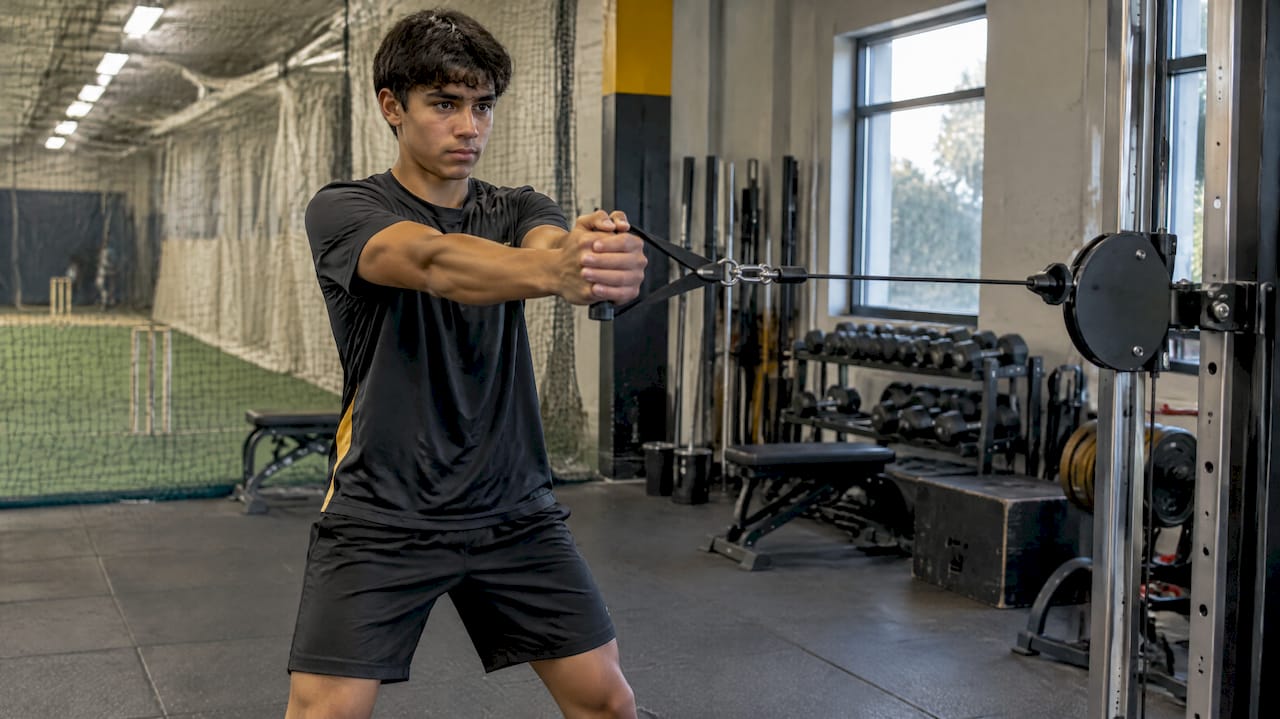
Progress load every two to three weeks once a player owns the technique at the current weight, and keep core sessions to two or three per week rather than daily, since the pattern needs recovery like any other strength stimulus.
Position-specific strength priorities for your role
Not every player needs the same programme, and treating bowlers, batsmen and fielders identically wastes training time that none of them have much of.
- Fast bowlers need posterior chain strength and eccentric hamstring capacity above everything else, since the front leg absorbs enormous braking force on landing. Hip stability work (banded lateral walks, single-leg glute bridges) protects against the asymmetric loading of a bowling action, and workload caveats apply here more than anywhere: strength gains mean nothing if overs are not also managed.
- Batsmen benefit most from rotational power work (cable woodchops, medicine ball rotational throws) that transfers directly into bat speed, plus scapular control exercises (band pull-aparts, prone Y-raises) to handle repeated short-lever shots. Single-leg stability (step-ups, Bulgarian split squats) supports the base players rotate from against fast, short-notice deliveries.
- Fielders and wicket-keepers rely on reactive power and deceleration strength, since diving, sprinting and sudden direction changes define the role. Box jumps and lateral bounds build the elastic quality needed, while deceleration-specific work (drop lunges, eccentric step-downs) directly trains the braking action of a slide-and-field movement. Shoulder prehab (external rotation work, scapular stability drills) matters for throwing volume across a long day in the field.
A micro-programme goal for each role keeps things simple: bowlers aim to add eccentric hamstring strength and hip control without adding bowling volume; batsmen aim to build rotational power that shows up as bat speed, not just gym numbers; fielders aim to reduce soft-tissue strain risk from repeated sprint-stop-throw sequences. None of this needs a complex periodisation model to start, just a clear sense of which quality matters most for the role in front of you.
Seasonal programming across the cricket year
Strength training in cricket works best as a progression across three distinct phases rather than the same session repeated year-round.
- Off-season (foundational phase): Higher training volume, technical focus, and correcting imbalances identified during the previous season. This is the window to build base strength in RDLs, Nordic lowers, and squat patterns before intensity ramps up. Sessions run three to four times per week with lower cricket-specific skill demand competing for time.
- Pre-season (conversion phase): Shift emphasis from raw strength toward power and plyometrics, converting the base built in the off-season into speed and explosiveness. This is also where combined skill-and-conditioning sessions become valuable. A practical example from the strength and conditioning literature shows that combining skill-based and conditioning work inside the same net session more closely matches real match physiological loads than separate gym and skill blocks, though it requires closer monitoring of intensity since coaches lose some of the control a standalone gym session provides.
- In-season (maintenance phase): Drop volume but keep quality high. Two shorter, focused strength sessions per week, timed well clear of match days, maintain the gains built earlier without adding fatigue that compromises skill performance. This phase is about holding the line, not making further gains.
A 10-plus week progressive plan for bowlers moving from off-season into pre-season might look like weeks 1 to 4 focused on technique and base strength (RDLs, Pallof press, Nordic lowers at low volume), weeks 5 to 8 adding load and introducing plyometric elements (box jumps, bounds), and weeks 9 to 12 shifting toward power expression and net-integrated conditioning that mirrors actual bowling workload. Cricket Australia’s guidelines note that a safe progressive build for junior fast bowlers should extend beyond 10 weeks, giving bone, tendon and soft tissue time to adapt to bowling-specific forces and reducing lumbar stress fracture risk.
A sample weekly template in pre-season might run: Monday gym (power and posterior chain), Tuesday skill-focused net session, Wednesday combined skill and conditioning net, Thursday lighter gym (core and mobility), Friday rest or light skill work, with weekend matches or trial games. Adjust around your actual fixture list rather than following a template rigidly.
Practical sessions: gym work and net-integrated conditioning
Three ready-to-use sessions cover the main phases of a season.
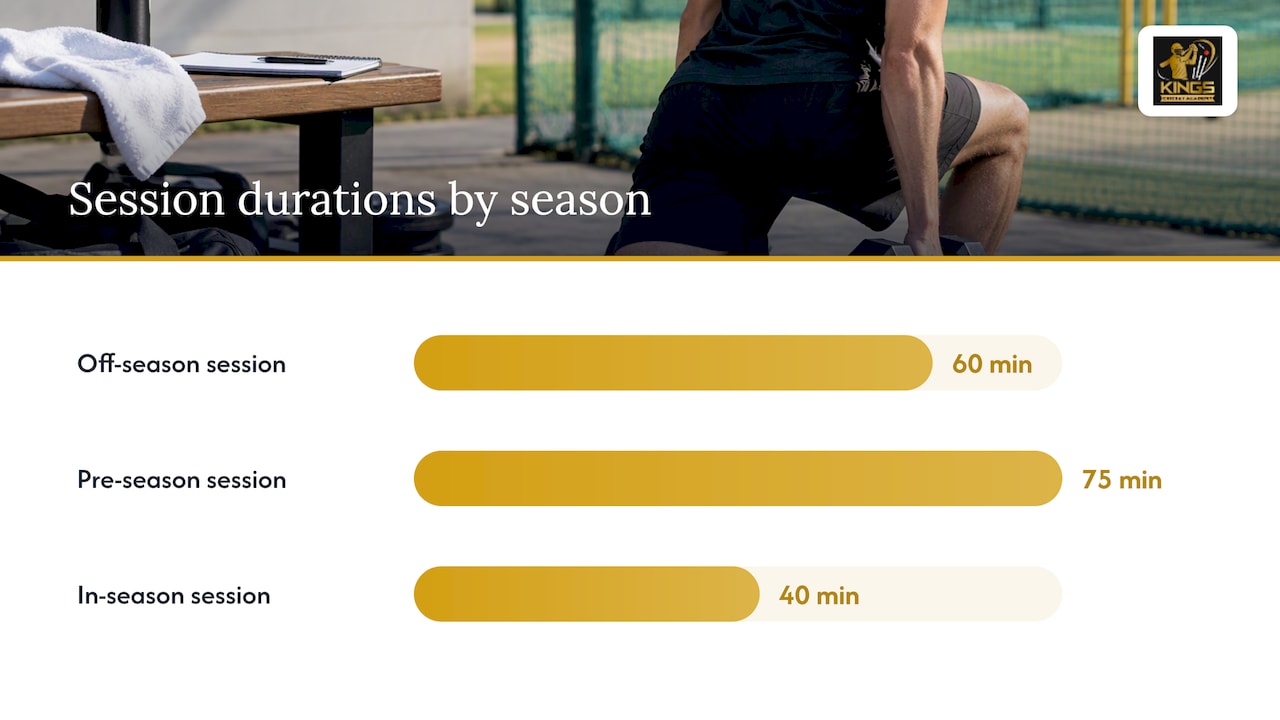
Off-season gym session (60 minutes): RDLs 4×8 at moderate load, Nordic hamstring lowers 3×6, Pallof press 3×10 per side, banded dead bug 3×10 per side, single-leg glute bridge 3×12 per side. Target RPE 6 to 7, building base capacity rather than chasing fatigue.
- Warm up with 10 minutes of dynamic mobility (leg swings, hip openers, thoracic rotations)
- Work through the strength circuit in the order above, resting 60 to 90 seconds between sets
- Finish with 10 minutes of light aerobic work to support recovery
Pre-season combined session (75 minutes): This blends gym power work with net-based conditioning. Box jumps 3×5, medicine ball rotational throws 3×6 per side, followed by a net-based conditioning block simulating match work-to-rest ratios: 6-ball overs bowled at match intensity with 90 seconds rest between overs, repeated for 6 to 8 overs. This mirrors the repeat-sprint ability demands bowlers actually face and builds conditioning specificity that a treadmill session cannot replicate.
In-season maintenance session (40 minutes): RDLs 3×6 at maintenance load, Nordic lowers 2×6, Pallof press 2×10 per side, plus 15 minutes of net work at controlled intensity. Keep this session at least 48 hours clear of match day.
Pro Tip: Log session RPE multiplied by session duration (sRPE) for every gym and net session. It is the simplest way to see when total workload is creeping up before an injury does.
For juniors and time-poor athletes, trim sessions to the first three exercises of each template and extend rest between sets rather than cutting exercises entirely. Technique quality matters more than volume at this age, and a shorter session done well beats a longer one done sloppily. Coaches running junior sessions can find more structured drill ideas in our cricket drills for junior players guide.
Injury prevention and workload management for bowlers
Strength work only protects players when it sits alongside sensible workload limits, particularly for junior fast bowlers whose bones and tendons are still adapting to adult-level forces.
- Cricket Australia’s junior bowling guidelines recommend a maximum of three bowling days per week for juniors, at least one full rest day after bowling, and a scheduled full-week break every 10 to 12 weeks to reduce lumbar stress injuries
- Progressive loading beyond 10 weeks allows bone, tendon and soft tissue to adapt gradually to bowling-specific forces rather than spiking load too early in a season
- Nordic hamstring lowers and hip abductor work reduce lumbar and hamstring injury risk by building the eccentric and stabilising capacity that bowling actions demand repeatedly
- Session RPE (sRPE), overs and spell logs give coaches an objective record of workload rather than relying on how a bowler “feels” on a given day
Despite these guidelines being well known, a survey of Australian coaches found that while 92% were aware of national bowling workload recommendations, only 13% actually prescribed the recommended workloads, and just 23% engaged fast bowlers in structured resistance training. That gap between knowing the guidelines and applying them is where most preventable injuries happen.
Red flags that warrant a physio referral rather than continued training include persistent lower back pain lasting more than a few days, hamstring tightness that does not ease with normal warm-up, or any sharp pain during a bowling action. For a broader look at how common injuries develop and where coaching intervention helps, our guide to common cricket injuries covers the mechanisms in more detail.
Testing and monitoring your progress
Objective testing stops programming from being guesswork and gives coaches a clear signal for when to progress or pull back load.
- The 30:15 intermittent fitness test alternates 30 seconds of running with 15 seconds of recovery, individualising conditioning targets based on a player’s own capacity rather than a generic benchmark
- Repeat sprint ability (RSA) protocols, such as a 25-metre shuttle repeated multiple times, measure how well a player maintains speed under fatigue, directly relevant to a bowler’s ability to hold pace across a spell
- The Star Excursion Balance Test (SEBT) measures dynamic balance and single-leg control, useful for picking up asymmetries before they become injuries
- Simple strength markers, such as estimated 1RM on the RDL or a timed Nordic lower hold, track posterior chain progress without needing a full 1RM test, which carries unnecessary risk for most club-level players
Ball- or radar-speed measures link directly to strength targets: if a bowler’s pace plateaus despite consistent training, the strength testing often reveals a hip or hamstring deficit holding back transfer from gym to run-up. The strength and conditioning for fast bowlers review recommends repeat-sprint protocols and the 30:15 test specifically for individualising this kind of conditioning work.
Testing every four to six weeks gives enough time to see genuine change without over-testing and eating into training time. Use results to adjust the next block: a dip in SEBT reach or RSA decrement should trigger a temporary volume reduction and renewed focus on the stability and eccentric work covered earlier, rather than pushing through.
How Kings Cricket Academy applies these principles
At Kings Cricket Academy, strength and conditioning principles get applied directly inside coached sessions rather than treated as separate from skill work. Our six dedicated lanes, fitted with bowling machines and radar speed monitors, let coaches pair a bowler’s strength progress with actual measured pace, so a hip stability programme can be checked against whether run-up speed is actually improving. HD video analysis gives a technical read on whether strength gains are translating into cleaner mechanics, not just heavier lifts. For fast bowlers working through a progressive loading block, fast bowling coaching sessions fold these checks into the normal training rhythm, with junior programmes following the same structured, supervised progression Cricket Australia’s guidelines recommend.
Train smarter with Kings Cricket Academy
Reading about anti-rotation drills and workload caps is one thing. Applying them inside an actual net session, with a coach watching your mechanics and a radar gun confirming whether the work is paying off, is another.

Our indoor lanes give you weather-proof access to bowling machines, sidearm setups and HD video analysis year-round, so strength gains get tested against real pace and technique data rather than guesswork. Junior programmes follow the same supervised, progressive structure covered above. If you want this integration without building your own gym programme from scratch, book a session through our memberships page or check private coaching options to get started.
FAQ
What is the 3-3-3 rule in gym training?
The 3-3-3 rule is not a standard cricket strength training protocol, and definitions vary widely depending on the source. Rather than follow an undefined rule, cricketers are better served by the role-specific guidance in this article, such as posterior chain work for bowlers and rotational power for batsmen.
What are five strength exercises every cricketer should know?
A strong starting five are RDLs, Nordic hamstring lowers, Pallof press, banded dead bug and single-leg glute bridges, all covered in detail in the core and posterior chain section above. These target the rotational and posterior-chain qualities most linked to cricket-specific injury prevention.
What exercises help most with cricket-specific fitness?
Eccentric hamstring work (Nordic lowers), rotational core training (Pallof press, cable woodchops) and repeat-sprint conditioning cover the main physical demands of batting, bowling and fielding. Injury prevention research in cricket links eccentric lower-limb training and plyometrics to both reduced injury risk and improved bowling and batting performance.
How often should cricketers strength train each week?
General public health guidance from Healthdirect recommends strength training at least twice a week for adults, with a professional movement screen before starting a new programme. Cricketers typically adjust this across the season, training three to four times weekly in the off-season and dropping to two shorter sessions in-season to manage fatigue around matches.
Does Kings Cricket Academy offer strength and conditioning coaching?
Kings Cricket Academy’s coaching focuses on cricket-specific skill development, fast bowling technique and batting, supported by radar speed monitoring and HD video analysis to track progress. Strength principles get integrated into these sessions rather than offered as a standalone gym programme, with details available through our private coaching page.
Sources
- Cricket Australia junior bowling guidelines
- Exercise-based injury prevention trial in adolescent pace bowlers (JSAMS, 2020)
- Injury prevention strategies in cricket (Strength & Conditioning Journal)
- Combining skill and conditioning sessions for professional cricketers: a practical example
- Strength training for beginners (Healthdirect)
Recommended
- Best Cricket Practice Nets In Sydney
- Cricket Drills For Junior Players: Batting, Bowling & Fielding
- Cricket Training Tips